FLEX
Roland Sitar
Type: -NO ENTRY-
TRL: 6-7
Supporting of Flex trails and simulation of FAIRWork tools - after Evaluation and success implementation in factory environmental
IPR / Licence
IP: Authorship
Contact Person
Information
In FLEX two use cases were tackled in detail:
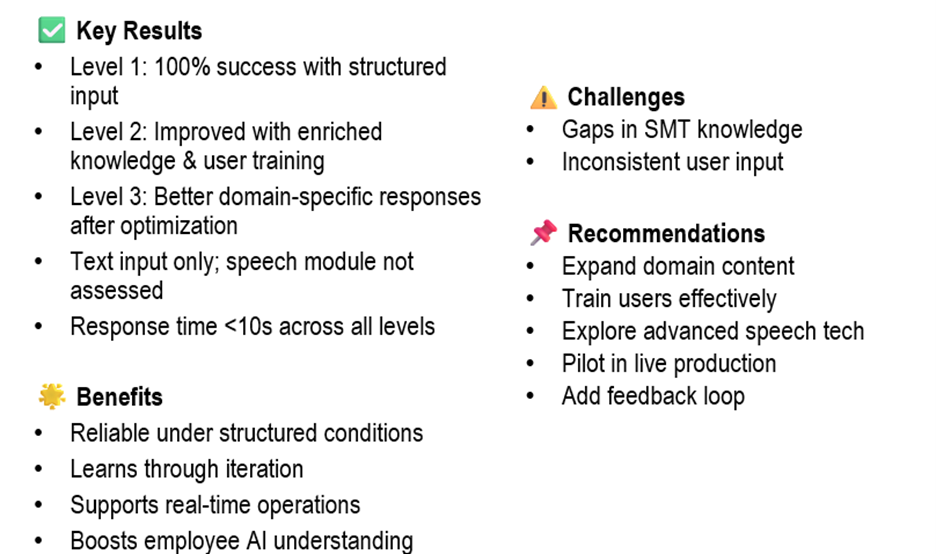
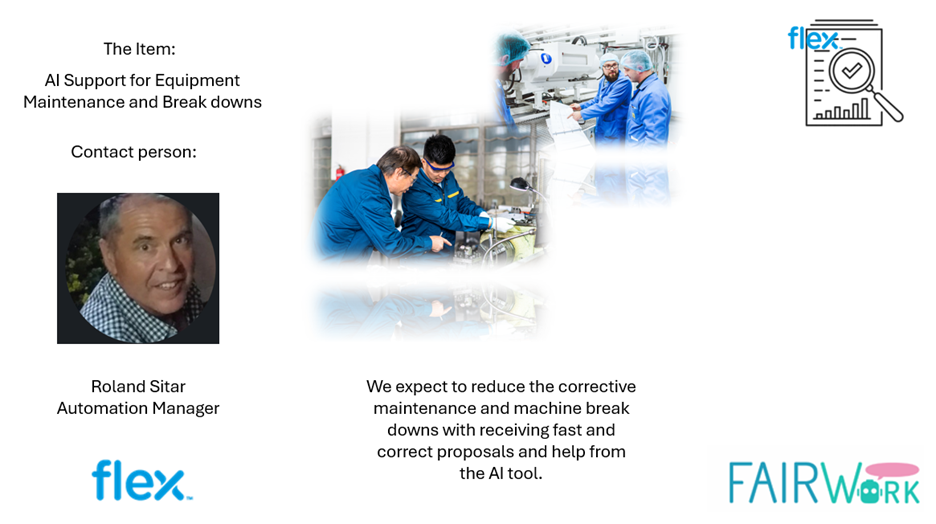
Improve Information Access to Support Maintenance
The increasing complexity of automated production systems in the electronics manufacturing sector has led to a rise in maintenance demands and machine breakdowns. At Flex Althofen, the annual volume of unplanned repair interventions has reached approximately 8,000 cases, significantly impacting production continuity and resource allocation. This situation is further aggravated by the growing number of inexperienced operators, whose limited technical knowledge often results in extended downtimes and frequent reliance on the maintenance team for minor issues.
To address these challenges, there is a clear need for a support system that empowers machine operators to independently resolve routine problems, thereby reducing the burden on maintenance personnel and improving overall system availability. Artificial Intelligence (AI) offers promising capabilities in this context, particularly in the form of intelligent decision support systems (DSS) that can provide real-time, context-sensitive guidance based on existing knowledge repositories.
Operational Context
Department involved: Maintenance and Production Activity: Supporting Maintenance and Production to maintain and break downs of equipment Current method: Time-consuming searches in various sources and tying up resources due to lack of experience
FAIRWork Solution
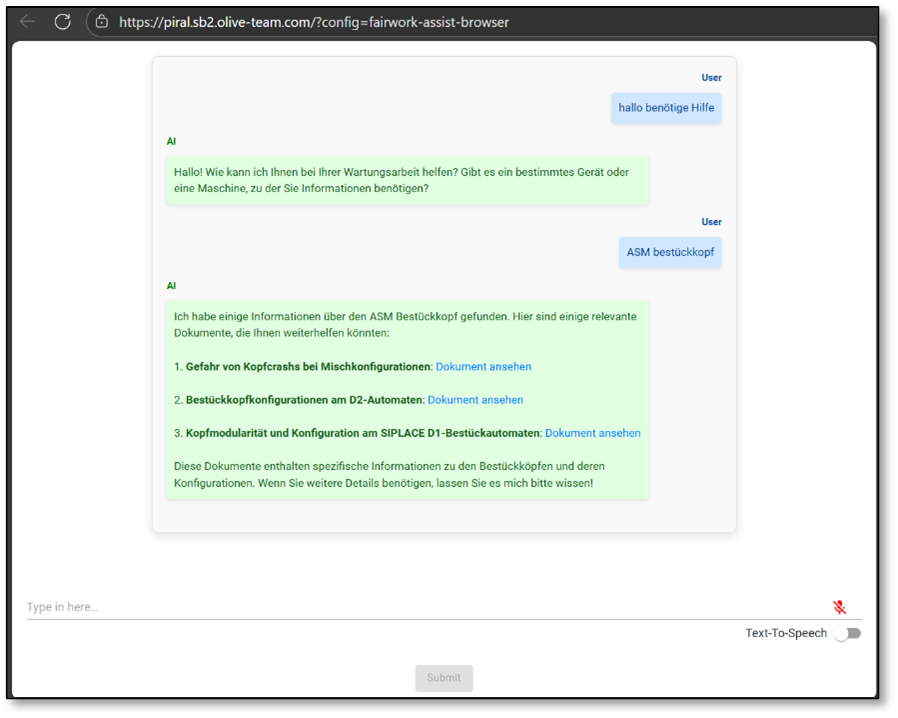
AI Service: An AI-powered assistant system is designed to enable machine operators to independently resolve simple breakdowns, relieve the maintenance team, and improve Overall Equipment Effectiveness (OEE)
Technologies: a microservice-based platform that enables modular UI design, workflow configuration, and AI integration for diverse industrial applications.
Observed Benefits
AI assistance could help resolve ~2,400 tickets/year without maintenance team involvement Benefits: reduced workload, faster response times, improved operator competence, and increased system efficiency
Summary and Conclusions
Support Validation of Calibration Documents
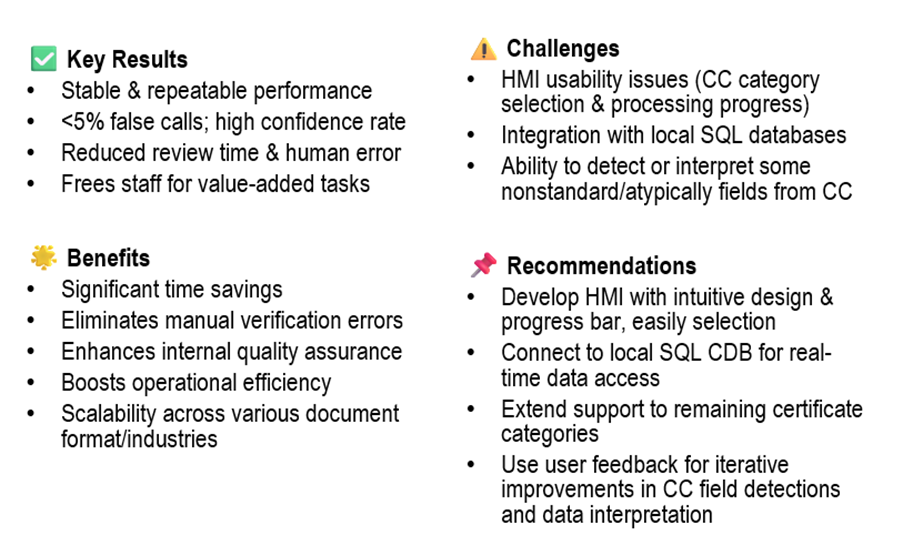
In Flex Timisoara verification of Calibration Certificates (CC) in PDF format is currently a manual, repetitive, time-consuming and error-prone process. Each calibration certificate received from the calibration service provider must be carefully checked for any discrepancies or missing or incorrect information.Employees must manually check instrument details (model, type, manufacturer, serial number), calibration dates (calibration and expiry), calibration results (measured values, deviations, uncertainties), measuring equipment information (for traceability), and formal aspects (signatures, page numbering, completeness). The current manual verification of calibration certificates is a time-consuming, repetitive, and error-prone process that demands meticulous attention to critical data points his exhaustive manual review, exacerbated by the sheer volume of certificates, significantly increases the risk of human error. Overlooked discrepancies can have severe repercussions, potentially leading to the use of faulty measuring equipment and compromising product or service quality.
To address these challenges and optimize the process, an AI-powered application was developed to automate the verification of Calibration Certificates. This application leverages AI to analyze certificates, identify discrepancies, and automatically generate a comprehensive report highlighting any missing or incorrect information. This automated solution is expected to drastically reduce review time and eliminate the likelihood of human error, leading to a much higher level of accuracy and reliability in the certificate review process. This will bolster internal quality assurance and allow staff previously dedicated to manual verification to be reassigned to more value-adding activities.
Operational Context
Department involved: Engineering & Calibration Laboratory Activity: Verification of Calibration Certificate Current method: Manual verification of calibration certificates involves repetitive steps and carries a risk of human error
FAIRWork Solution
AI Service: AI-powered service that automates calibration certificate verification by extracting data, checking accuracy, and generating compliance reports.
Technologies:
- Rule-Based Algorithm: Ensures consistent logic for data extraction and validation.
- Standalone Application: A lightweight .exe file that runs independently on any PC or laptop. It supports multiple document uploads, report viewing, and CC category switching via a config file.
- Calibration Database (CDB): Excel-based mirror of the local SQL database used for cross-verification.
- Browser-Based Reporting (html): Displays validation results per certificate for easy review
Observed Benefits
The tool proved reliable, accurate, and scalable—supporting digitalization and reducing manual effort in calibration certificate validation.
Summary and Conclusions